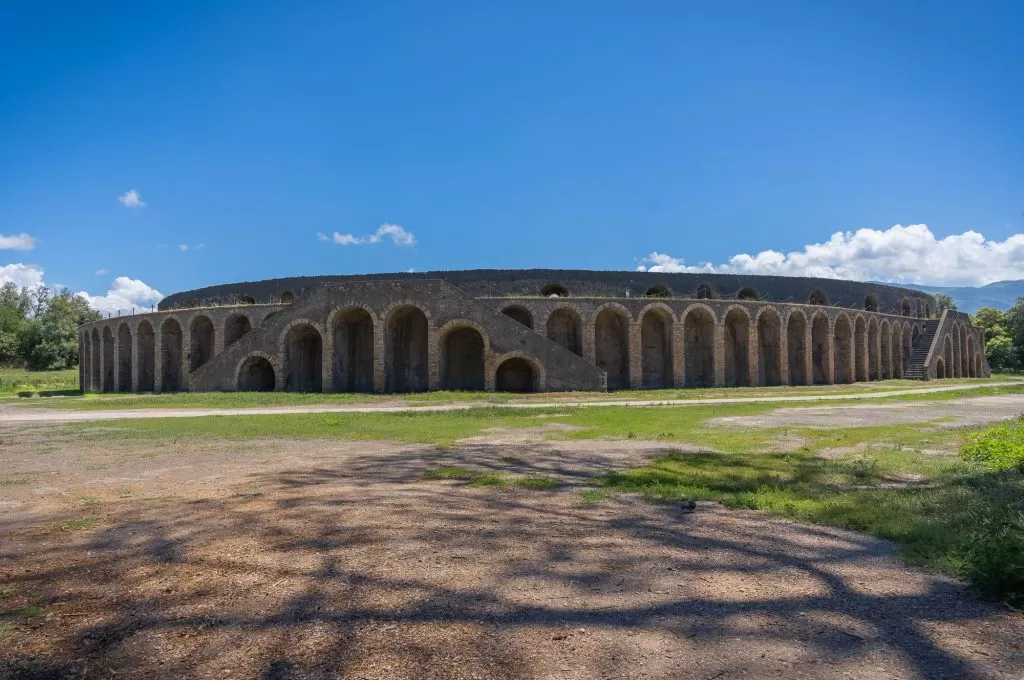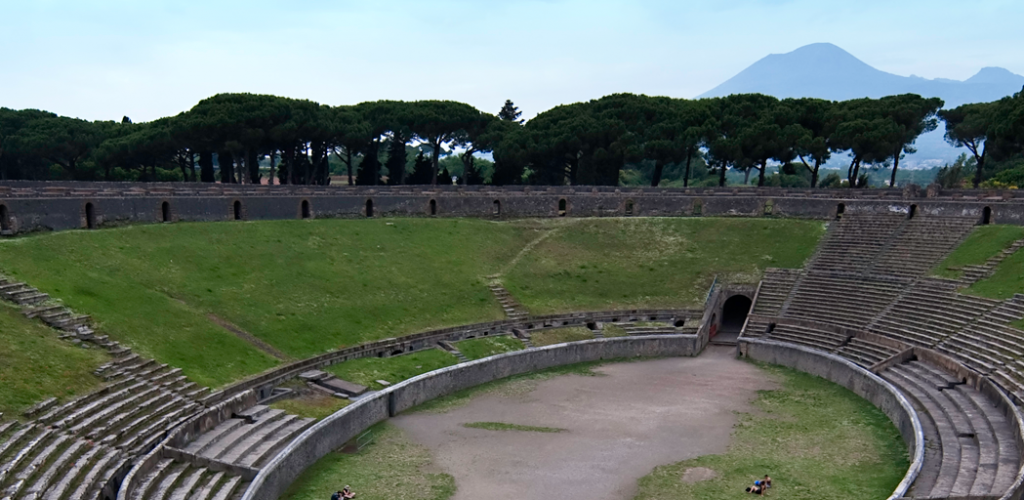
The Amphitheater of Pompeii
The Amphitheater of Pompeii is one of the most important monuments of the Roman world and represents the oldest surviving stone amphitheater known today. Constructed around 70 BC, shortly after the Roman colony of Colonia Cornelia Veneria Pompeianorum was established by the dictator Lucius Cornelius Sulla following the Social War, the building provides extraordinary evidence for the development of Roman public entertainment architecture before the construction of the Colosseum in Rome by more than a century. Its exceptional state of preservation allows archaeologists and historians to reconstruct not only the architectural evolution of amphitheaters but also the political, social, and ideological role of gladiatorial spectacles in Roman society.
The amphitheater was built in the southeastern sector of the city, close to the city walls and near the palaestra, an area devoted to athletic and military training. Its position was carefully chosen: by exploiting the natural slope of the terrain and the proximity of the fortification walls, the builders reduced the amount of artificial substructures required to support the seating cavea. An inscription discovered near the entrances records the names of the two magistrates responsible for financing the monument, the duoviri Quinctius Valgus and Marcus Porcius, who paid for the construction at their own expense. This act of civic benefaction, known as evergetism, was a common political strategy in Roman municipalities, through which wealthy elites increased their prestige, influence, and public reputation by funding monumental architecture for the community.
Architecturally, the Amphitheater of Pompeii represents a transitional phase in the evolution of Roman entertainment buildings. Earlier gladiatorial combats in Italy often took place in temporary wooden arenas or adapted spaces such as forums. Pompeii instead offers one of the earliest examples of a permanent amphitheater specifically designed for gladiatorial spectacles and venationes, or wild beast hunts. The structure measures approximately 135 by 104 meters and could accommodate an estimated 20,000 spectators, a number exceeding the population of Pompeii itself. This suggests that visitors arrived from surrounding towns and rural areas during major spectacles, transforming games into regional events of enormous social importance.
Unlike the later Flavian Amphitheater in Rome, commonly known as the Colosseum, the Pompeian amphitheater lacks the complex system of vaulted substructures typical of Imperial architecture. Much of the cavea was instead supported directly by embankments of earth. The arena itself occupies the central elliptical space and was surrounded by a high podium wall designed to protect spectators from gladiators and animals. The seating arrangement reflected the rigid hierarchy of Roman society. The lowest and most prestigious seats were reserved for local magistrates, priests, and elite citizens, while the upper levels accommodated ordinary inhabitants, women, freedmen, foreigners, and possibly slaves. The architecture therefore materialized the social order of Roman civic life, reinforcing distinctions of status and identity through spatial organization.
Access to the amphitheater was highly sophisticated and reveals remarkable engineering efficiency. Spectators entered through vaulted corridors and stairways carefully designed to facilitate rapid circulation and crowd management. Separate entrances existed for gladiators and officials, emphasizing the ceremonial dimension of the spectacles. The arena itself was probably covered with sand (harena in Latin, from which the modern word “arena” derives) intended to absorb blood and improve footing during combat. Evidence also suggests the existence of a velarium, a large retractable awning used to provide shade for spectators during hot weather, although the exact mechanism remains uncertain in Pompeii due to the incomplete preservation of the upper structures.
Gladiatorial combats held in the amphitheater were deeply embedded in Roman political and religious culture. Originally associated with funerary rituals in central Italy, gladiatorial games evolved into mass spectacles expressing Roman ideals of courage, discipline, endurance, and martial virtue. Gladiators themselves occupied an ambiguous social position. Although often slaves, prisoners of war, or condemned criminals, successful gladiators could achieve fame, wealth, and popular admiration. Graffiti discovered throughout Pompeii demonstrate the extraordinary popularity of these fighters. Many inscriptions celebrate victorious gladiators, recording the number of victories achieved and the enthusiastic support of fans, including women. Some graffiti openly express romantic fascination with famous fighters, illustrating how gladiators became celebrity figures within Roman urban culture.
The amphitheater also served as a powerful instrument of political consensus. Public spectacles were often sponsored by local magistrates seeking electoral support or social prestige. The organization of games required enormous financial investment, including the purchase or rental of gladiators, animals, stage machinery, musicians, and decorations. Through these events, elites demonstrated generosity and reinforced loyalty to Roman authority. The spectacles simultaneously entertained the population and symbolized the dominance of Roman civilization over violence, chaos, and foreign enemies.
One of the most significant historical events associated with the amphitheater occurred in AD 59 during the reign of Emperor Nero. The Roman historian Tacitus describes a violent riot that erupted during gladiatorial games between spectators from Pompeii and the nearby town of Nuceria. What began as verbal insults escalated into a bloody conflict involving stones, weapons, and numerous casualties. The episode was so serious that Nero ordered the closure of the amphitheater for ten years and dissolved certain local associations involved in organizing the games. A remarkable fresco discovered in Pompeii vividly depicts the riot, showing combat taking place both inside and outside the amphitheater. This painting represents one of the rare visual documents illustrating actual events in Roman public entertainment and provides invaluable insight into crowd behavior and civic rivalries in the ancient world.
The earthquake of AD 62, which severely damaged Pompeii years before the eruption of Vesuvius, also affected the amphitheater. Archaeological evidence indicates that restoration works were undertaken after the earthquake, demonstrating the continued importance of public spectacles for civic identity and urban life. Repairs included reinforcement of structural elements and modifications to access systems. When Mount Vesuvius erupted in AD 79, the amphitheater was still functioning and remained one of the largest public buildings in the city.
The eruption paradoxically ensured the monument’s preservation. Buried beneath volcanic ash and pumice, the amphitheater escaped the extensive stone robbing and later urban occupation that destroyed many ancient structures elsewhere in Italy. Systematic excavations beginning in the eighteenth century gradually revealed the building, attracting enormous interest from scholars, artists, and travelers participating in the Grand Tour. During the nineteenth and twentieth centuries, the monument became fundamental for the study of Roman entertainment architecture and the origins of amphitheater design.
Modern archaeological research has employed advanced methods to analyze the structure, including architectural surveys, photogrammetry, geological studies, and digital reconstructions. These investigations have clarified construction techniques, phases of restoration, drainage systems, and spectator movement patterns. Studies of acoustic properties suggest that the amphitheater was carefully designed to maximize the audibility of announcements and crowd reactions. Meanwhile, analysis of graffiti and inscriptions has contributed significantly to understanding the social composition of audiences and the economic organization of spectacles.
Today, the Amphitheater of Pompeii remains one of the most evocative monuments of the Roman world because it preserves not only architecture but also the atmosphere of collective experience that characterized Roman public life. Unlike many later amphitheaters altered over centuries, Pompeii offers a uniquely authentic image of an early Roman arena within its original urban context. The monument illustrates how entertainment, politics, religion, violence, and social hierarchy were inseparably intertwined in Roman civilization. At the same time, it reveals the extraordinary engineering capabilities of Roman builders and the cultural importance of spectacle in maintaining civic identity and imperial ideology.
The Amphitheater of Pompeii therefore stands not merely as an archaeological ruin, but as a crucial document for understanding the mentality, social structure, and urban culture of the ancient Roman world.