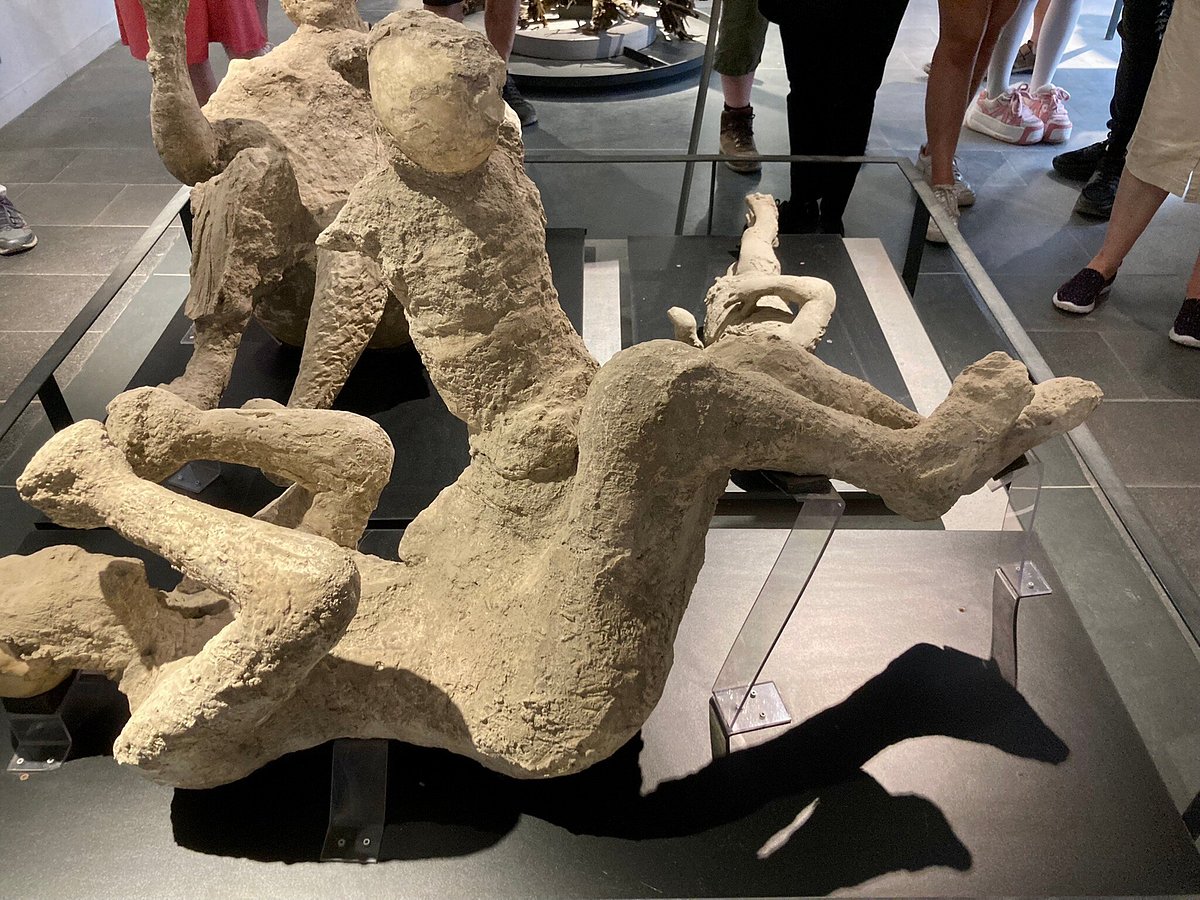
The plaster casts of Pompeii
The Plaster Casts of Pompeii: Archaeology, Science, and Memory
Among the most powerful and emotionally moving discoveries in the history of archaeology are the plaster casts of Pompeii. These haunting forms — victims frozen forever in the final moments of the eruption of AD 79 — transformed the study of the ancient world by providing an unprecedented connection between modern observers and the individuals of Roman antiquity. More than simple archaeological artifacts, the casts represent a unique combination of scientific investigation, artistic reconstruction, forensic anthropology, and cultural memory.
The Eruption of AD 79 and the Formation of the Voids
When Mount Vesuvius erupted in AD 79, Pompeii was buried under several meters of volcanic material composed primarily of pumice, ash, and pyroclastic deposits. During the early phase of the eruption, pumice stones accumulated gradually, causing roofs to collapse and forcing many inhabitants to flee. Later, devastating pyroclastic currents and surges — extremely hot mixtures of volcanic gas, ash, and debris — overwhelmed the city and killed those who remained.
Over time, the bodies buried beneath the ash decomposed. Organic tissues disappeared, while the surrounding volcanic material hardened into a compact layer of tuff-like sediment. As the soft tissues decayed, they left empty cavities within the ash deposits. In some cases, bones remained inside these voids; in others, even skeletal material partially deteriorated due to humidity and chemical processes.
These cavities preserved the exact negative impression of the victims’ bodies, including facial features, folds of clothing, hairstyles, and even expressions of pain or protection. The volcanic matrix essentially acted as a natural mold.
Giuseppe Fiorelli and the Invention of the Casting Technique
The scientific breakthrough came in 1863 thanks to the Italian archaeologist Giuseppe Fiorelli, director of the excavations at Pompeii. While excavating areas of the city, Fiorelli observed voids in the hardened ash containing human bones. He understood that these spaces corresponded to decomposed bodies and devised an innovative method to preserve their shapes.
Fiorelli injected liquid plaster into the cavities through small openings. Once the plaster hardened, archaeologists carefully removed the surrounding volcanic material, revealing detailed casts of the victims. The result was extraordinary: human beings appeared almost resurrected from antiquity, captured in the precise posture in which death had overtaken them nearly two thousand years earlier.
Fiorelli’s method revolutionized archaeology. Before his innovation, excavations often focused primarily on architecture, inscriptions, and valuable objects. The plaster casts shifted attention toward ordinary people and daily life, introducing a profoundly human dimension to archaeological research.
Scientific Importance of the Casts
The casts are not merely emotional representations; they are also important scientific documents. Modern studies combining archaeology, physical anthropology, medicine, and volcanology have provided valuable information about the victims and the eruption itself.
Position of the Bodies
The positions preserved in the casts help reconstruct the final moments of the disaster. Some victims are shown lying face down, possibly suffocated by ash and toxic gases. Others appear curled in defensive postures, suggesting thermal shock or attempts to protect themselves from collapsing debris.
Several casts reveal groups of people sheltering together, while others depict individuals carrying personal belongings, jewelry, or money, indicating attempts to escape.
Clothing and Social Status
Impressions of fabrics, sandals, belts, and accessories occasionally survive in the plaster. Combined with associated objects, these details allow scholars to infer aspects of social class, occupation, and lifestyle.
Some victims wore expensive jewelry or finely crafted garments, while others appear to have belonged to lower social strata. The casts therefore offer rare evidence for the diversity of Pompeian society.
Paleopathology and Health
The skeletal remains inside the casts provide information about health conditions, nutrition, diseases, and physical labor. Modern anthropological studies using CT scanning and digital imaging have identified evidence of arthritis, dental disease, bone fractures, and muscular stress markers.
Analysis of teeth and bones suggests that many Pompeians had relatively good nutrition, partly due to the Mediterranean diet rich in cereals, fish, fruits, and olive oil.
Volcanological Research
The casts also contribute to volcanology. By examining body positions, ash layers, and thermal effects on bones, scientists can better understand the dynamics of the eruption. Research indicates that many victims died rapidly from extreme heat generated by pyroclastic surges, with temperatures potentially exceeding 250–300°C.
This evidence has helped revise earlier theories that emphasized slow suffocation alone. Instead, many inhabitants likely died almost instantly from thermal shock and exposure to superheated gases.
The Evolution of Casting Techniques
Although Fiorelli’s plaster technique remains iconic, modern archaeology has developed more advanced and less invasive methods.
Resin Casts
In recent decades, archaeologists have sometimes used transparent resin instead of plaster. Resin allows researchers to observe skeletal remains inside the casts without destroying them and offers greater structural stability.
Digital Reconstruction
Technologies such as laser scanning, photogrammetry, and CT imaging now enable scholars to digitally reconstruct bodies and cavities in three dimensions. These methods reduce the need for invasive interventions and preserve valuable information for future research.
Digital models can also reveal hidden details, such as bone positioning, pathological conditions, or objects buried within the ash.
Conservation Challenges
The plaster casts are extremely fragile. Exposure to humidity, temperature fluctuations, salts, biological growth, and mass tourism threatens their preservation. Conservation teams continuously monitor environmental conditions and apply restoration treatments to stabilize cracks and deterioration.
Several casts have undergone extensive restoration campaigns in the 21st century, particularly during the Great Pompeii Project, aimed at safeguarding the archaeological site.
Famous Casts of Pompeii
Certain casts have become internationally recognized symbols of the tragedy of Pompeii.
The Garden of the Fugitives
One of the most famous groups is located in the so-called Garden of the Fugitives, where thirteen victims were discovered together while attempting to escape the city. Their poses vividly convey fear, desperation, and human suffering.
The Dog Cast
Equally famous is the cast of a dog found chained in a house. The twisted body vividly illustrates the animal’s agony during the eruption and remains one of the most striking examples of animal casts from Pompeii.
Children and Families
Some casts depict children embraced by adults or families gathered together, emphasizing the deeply human dimension of the catastrophe and creating a powerful emotional response among visitors.
Ethical Questions and Modern Interpretation
The display of human remains inevitably raises ethical questions. Some scholars argue that the casts risk transforming ancient victims into spectacles for tourism. Others maintain that they serve as important memorials preserving the dignity and humanity of those who died.
Modern museum interpretation increasingly emphasizes respect, historical context, and scientific education rather than sensationalism. Today the casts are understood not only as archaeological finds but also as testimonies of individual human lives interrupted by natural disaster.
Pompeii and the Birth of Modern Archaeology
The plaster casts played a crucial role in shaping modern archaeology as a discipline focused not merely on monuments and treasure, but on people, society, and lived experience. They transformed Pompeii into one of the most important archaeological laboratories in the world.
Unlike many ancient cities known only through ruins or texts, Pompeii preserves a direct imprint of human existence. The casts provide an almost unparalleled encounter with antiquity, collapsing the distance between the modern observer and the Roman past.
They remind us that behind every archaeological site were real individuals — men, women, children, slaves, merchants, animals, and families — whose lives ended suddenly beneath the ash of Vesuvius.
For this reason, the plaster casts of Pompeii remain among the most extraordinary discoveries ever made in the history of archaeology.